
Choosing Mediation or Collaboration: A Staten Island Divorce Attorney’s First Answer
A divorce attorney on Staten Island knows that most people facing the end of a marriage are not thinking about courtroom strategy; they are thinking about their children, their home, and their financial future. Divorce can leave lasting emotional and legal scars, and the fear of a drawn-out contested divorce that disrupts child custody schedules and drains savings is real.
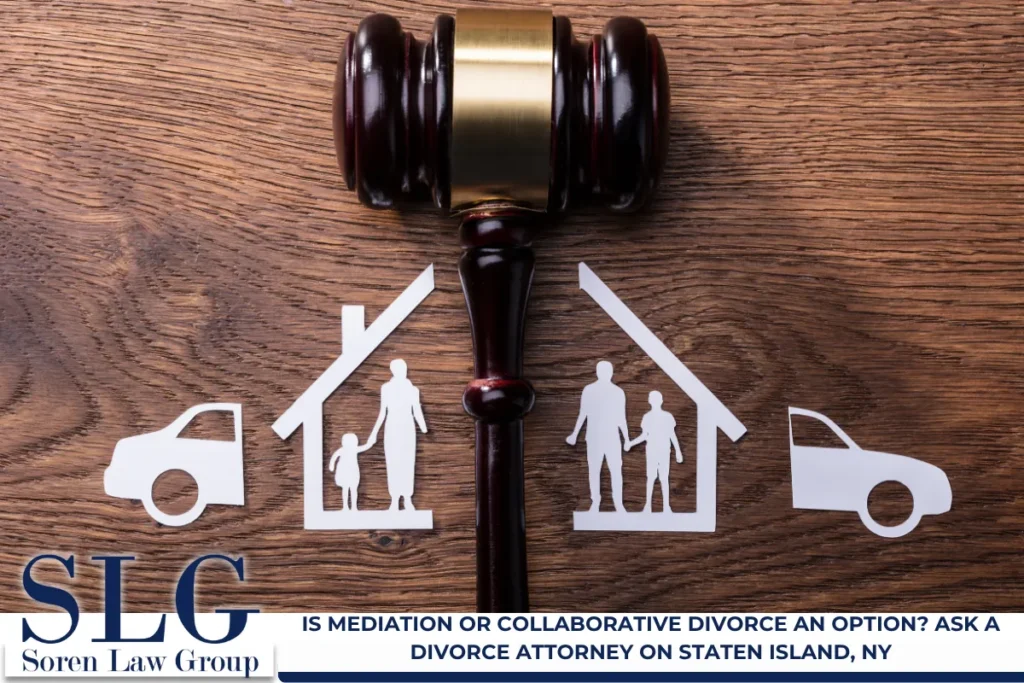
The good news: both mediation and collaborative divorce are structured, out-of-court options available under divorce law in New York. Divorce mediation is a viable alternative to traditional litigation, and collaborative divorce is a widely recognized option for resolving disputes. Each process protects legal rights while avoiding many downsides of a fully contested case. A qualified divorce lawyer can help you decide which path makes sense for your specific circumstances.
Key Takeaways
- Mediation and collaborative divorce are both available to Staten Island residents and can keep you out of a contested divorce trial in the Supreme Court of Richmond County.
- The Supreme Court in Richmond County still issues the final divorce judgment, even when spouses reach agreements through mediation or collaborative law outside of court.
- Mediation uses a neutral third party mediator to facilitate discussion, while collaborative divorce gives each spouse their own attorney committed to settling without litigation.
- Both options can reduce cost, time, and conflict, which matters for Staten Island families with ongoing co-parenting needs.
- Speaking with a local divorce attorney early helps you identify which process fits your goals, communication style, and safety concerns.
How Divorce Works on Staten Island’s Supreme Court of Richmond County
All divorces for Staten Island residents are finalized in the Supreme Court, Richmond County. This is true whether you resolve your case through mediation, collaborative law, or a traditional contested divorce. New York courts encourage alternative dispute resolution methods like mediation and collaborative divorce, but the court retains final authority over every judgment.
The basic steps:
- Meet New York residency requirements (for example, one or both parties must have lived in the state continuously for at least one year with qualifying ties, or two years without them).
- File a Summons with Notice or Summons and Complaint in Richmond County.
- Serve the other party.
- Resolve outstanding issues: child custody, child support, equitable distribution of marital property, and spousal support.
- Submit either an uncontested divorce packet with a written agreement or proceed to contested hearings.
Agreements reached through mediation or collaboration are incorporated into a stipulation of settlement and submitted to the court. Successful mediation or collaboration can prevent the need for repeated court involvement, but the judge reviews every agreement before granting a final Judgment of Divorce. Accurate financial information disclosure is required at every stage.
What Is Divorce Mediation for Staten Island Families?
Divorce mediation is a voluntary, confidential process where a neutral mediator helps spouses reach agreement on issues like parenting time, property division, and debt allocation. Mediation involves a neutral third-party mediator who facilitates communication but does not act as a divorce lawyer for either spouse. Mediators do not provide legal advice during mediation sessions and do not represent either party.
Mediation sessions are typically held outside of court. Topics covered include:
- Child custody schedules and parenting plans
- Division of bank accounts, retirement accounts, and real estate
- Handling marital debt
- Child visitation arrangements
- Possible spousal support terms
Mediation helps resolve issues like child custody and property division in a setting where both spouses maintain control over outcomes. Sessions can often be completed in a matter of weeks and can be scheduled quickly and flexibly, which is one reason mediation often moves faster than litigation, reducing emotional stress.
Each spouse can and should retain an independent review attorney to explain rights before signing any mediated agreement. When mediation succeeds, it typically leads to an uncontested divorce filing in Richmond County, streamlining the court phase.
Collaborative Divorce and Collaborative Law: How the Process Differs from Mediation
Collaborative divorce is a structured, team-based approach to ending a marriage. The model was pioneered in the United States in 1990 and has since spread across the country as a recognized alternative to courtroom litigation, with many states—including Ohio in 2012—subsequently formalizing its practice through specific legislation. Each spouse must hire a specially trained collaborative attorney in New York; both spouses are required to have their own lawyer throughout the entire process.
The cornerstone of collaborative law is a legally binding participation agreement. In this collaborative agreement, both parties commit to:
- Full financial transparency
- Good faith negotiation
- Resolving all divorce matters without going to trial
The key distinction from mediation is that collaborative divorce attorneys actively advocate for each client during joint meetings, while still prioritizing problem-solving over courtroom tactics. Collaborative divorce encourages low conflict and candid negotiations, which can preserve family dynamics and reduce long-term damage.
Collaborative divorce can involve additional professionals like financial specialists, child specialists, or coaches to address complex financial issues or parenting issues. If either spouse decides to litigate, both collaborative attorneys must withdraw from the case. In collaborative divorce, attorneys must withdraw if negotiations fail, and the parties proceed with new counsel for any contested divorce in Supreme Court. This withdrawal clause creates a strong incentive for both sides to stay at the table.
Read Negotiations vs. Litigation: What Is the Approach of a Divorce Attorney on Staten Island, NY?
Comparing Mediation, Collaborative Divorce, and Traditional Litigation
No single divorce process is right for every family. The choice depends on safety, communication levels, and case complexity. Both mediation and collaborative divorce aim to reduce emotional and financial costs, and both allow couples to maintain privacy over sensitive matters. Here is how the three paths compare on key points:
- Control over outcomes: Mediation gives spouses the most direct control, since they negotiate terms themselves. Collaborative divorce embeds legal representation in each meeting. Litigation leaves final decisions to the judge.
- Cost: While mediation is typically more cost-effective (often running $3,000 to $8,000 total), collaborative divorce provides advocates for each spouse and usually costs $15,000 to $35,000 for moderately complex cases. Collaborative divorce can cost 80% to 90% less than a fully contested divorce, which can run far higher depending on court schedules, expert witnesses, and attorney fees.
- Privacy: Mediation and collaborative sessions are confidential. Litigation records are public.
- Time: Mediation can often move faster than litigation. Contested divorces can extend well beyond a year. Collaborative cases fall somewhere in between.
- Emotional impact: Less adversarial processes reduce strain on children and co-parenting relationships. Divorce impacts financial security, living arrangements, and children’s futures; keeping conflict low can soften that impact.
- Custody disputes: Both mediation and collaborative law allow parents to build detailed parenting plans. A contested divorce keeps maximum court oversight but is often more adversarial.
When Mediation or Collaborative Divorce May (or May Not) Be a Good Fit
Safety and honesty are baseline requirements for any out-of-court process. Neither mediation nor collaborative divorce is appropriate in cases involving domestic violence or severe conflict. Where active intimidation or coercion exists, the legal system may need to intervene through protective orders and court supervision.
Mediation tends to work well when:
- Both spouses are willing to sit in the same room (or on the same video call) and communicate respectfully
- Financial information can be disclosed fully and in good faith
- Issues are relatively straightforward; low conflict situations with clear marital assets
- Both parties agree to focus on co-parenting rather than winning
Collaborative divorce is often the right process when:
- The case involves significant assets, business ownership, or retirement accounts
- One or both parties want legal advice at the negotiation table from their own lawyer
- Moderate conflict exists, but both spouses want to avoid court
- Other professionals (financial analysts, child specialists) would help resolve complex property distribution or custody issues
Red flags pointing toward litigation:
- History of domestic violence or intimidation
- One spouse hiding bank accounts or refusing to share financial information
- Substance abuse affecting parental rights or decision-making
- Ignoring court orders or prior legal action
Suitability is highly individual and fact-dependent under New York law. An initial consultation with a family law attorney is the safest way to evaluate whether mediation, collaborative law, or traditional litigation fits your situation.
Key Issues to Resolve: Child Custody, Finances, and Property on Staten Island Divorces
Whether spouses use mediation, collaboration, or traditional negotiation, the core issues they must resolve are the same.
New York courts decide child custody based on the best interests of the child. Out-of-court processes give Staten Island families more flexibility to build detailed parenting plans covering parenting time, holidays, school schedules, and decision-making authority. A custody dispute that parents can resolve themselves often produces more workable arrangements than one imposed by a judge.
Equitable distribution governs how marital property and debt are fairly divided. New York law lists 13 to 14 statutory factors the court considers, including duration of marriage, each spouse’s income, contributions of a homemaker, and tax consequences. Careful disclosure of bank accounts, retirement accounts, and real estate is essential regardless of the process chosen.
Child support follows the Child Support Standards Act formula: 17% of combined parental income for one child, 25% for two, 29% for three, 31% for four, and at least 35% for five or more. Spousal maintenance does not follow a single rigid formula but is guided by statutory factors. Both can be tailored through negotiated agreements, as long as they comply with New York standards. Thorough financial information exchange during mediation or collaboration reduces surprises later and makes court approval of an uncontested divorce more likely.
Getting Started: How a Staten Island Divorce Lawyer Helps You Choose a Path
An initial consultation with a local divorce attorney is the safest way to evaluate your legal options before committing to mediation, collaboration, or filing contested. At that first meeting, the attorney typically reviews:
- Your goals for the divorce process
- Family circumstances, including any child custody or child visitation concerns
- Safety issues or power imbalances
- Income, marital assets, and debts
- Any urgent support or parenting issues
The attorney may walk through hypothetical scenarios, showing what your case might look like in mediation versus collaborative law versus a contested divorce in Richmond County Supreme Court. Early legal advice can prevent missteps, such as signing informal agreements or exchanging partial financial information without understanding long-term consequences to your financial stability.
Bring basic financial records to your first meeting: pay stubs, tax returns, mortgage statements, and retirement account summaries. These help the lawyer offer legal advice that is grounded in your actual numbers rather than guesswork. Whether your case involves a no fault divorce filing or a legal separation, a family law attorney can map out a realistic path forward.
Emotional Support and Practical Tips for Staten Island Families in Transition
Divorces are not just legal disputes. They involve grief, identity change, and parenting stress, especially in close-knit Staten Island communities where family dynamics play a visible role in daily life. Emotional support is not a legal weakness; it often makes it easier to stay focused and effective in negotiations.
Consider building a support team beyond your legal team: therapists, support groups, financial planners, or trusted friends who help manage financial strain and stress without escalating conflict. Before mediation or collaborative meetings, prepare a written list of priorities, practice calm communication, and avoid discussing legal strategy directly with children.
Choosing less adversarial processes can reduce long-term emotional damage for children by modeling problem-solving rather than constant conflict. For Staten Island families navigating family law issues, the way you handle the divorce process shapes your co-parenting relationship for years to come.
Staten Island Divorce Attorney – Soren Law Group
At Soren Law Group, we guide Staten Island residents through mediation, collaborative divorce, and litigated family law cases in the Supreme Court of Richmond County. Our legal team handles child custody, property division, spousal support, and every other issue that arises during a divorce, giving you clear answers so you can make informed decisions.
We take the time to explain your legal options, help you choose between avoiding court through mediation or collaboration, and stand ready to litigate when circumstances demand it. Our focus is on protecting your long-term financial stability and your family’s well-being.
Call us at (718) 815-4500 or fill out our contact form to schedule a confidential consultation. As your divorce attorney on Staten Island, New York, we are here to help you move forward with clarity and confidence.
Frequently Asked Questions
How does mediation affect the timeline for finalizing a divorce on Staten Island?
Mediation can shorten the overall timeline because many issues are resolved before filing or while the case is pending, reducing required court appearances. A typical sequence involves several mediation sessions over a few weeks to a few months, preparation of a written agreement, submission of uncontested divorce papers to the Supreme Court of Richmond County, and judicial review. Actual timing depends on how quickly both spouses respond, the complexity of property and parenting issues, and the court’s administrative processing schedule. Even with a complete mediated agreement, only the court can grant the final Judgment of Divorce. Many mediated cases resolve faster than fully contested divorces, which can extend well beyond a year.
Can we switch from mediation to collaborative divorce or litigation if things change?
Parties may end mediation at any time and move to collaborative divorce or a traditional contested case, since mediation is voluntary and non-binding until agreements are signed. If spouses started in a formal collaborative divorce and signed a participation agreement, switching to litigation triggers withdrawal of both collaborative attorneys, and new counsel must be retained. Information shared in mediation is generally confidential, but factual financial records like tax returns and bank statements can still be used in later proceedings. If you have concerns about safety, power imbalance, or stalled progress, discuss them privately with your individual attorney before deciding to switch. Changing processes does not mean failure; it reflects evolving needs in your divorce.
Is a mediated or collaborative divorce better for protecting my privacy?
Both mediation and collaborative divorce keep most discussions in private meetings rather than open court, which can protect family privacy on Staten Island. The final settlement and Judgment of Divorce filed with the Supreme Court become part of the court record, but the detailed back-and-forth negotiations typically do not. Sensitive topics, such as mental health treatment, business valuation, or specific parenting conflicts, are easier to address candidly in confidential sessions. Parties can work with their divorce attorneys to limit unnecessary personal detail in court-filed documents where appropriate and consistent with New York law. For families concerned about reputation or children’s privacy, these out-of-court options offer more discretion than fully litigated trials.
What happens if my spouse hides assets during mediation or collaborative divorce?
Full financial disclosure is required in New York divorces regardless of which process you choose. Hiding assets can lead to serious legal consequences and future court intervention. Attorneys can request documentation such as bank statements, tax returns, retirement account summaries, and business records to verify all financial information. If there is strong evidence of concealment, a divorce attorney may advise ending mediation or collaboration and pursuing formal discovery tools through legal action in Supreme Court. Courts can set aside agreements obtained through fraud or intentional nondisclosure and may impose sanctions on the dishonest party. If you suspect hidden assets, raise your concerns privately with counsel early, before signing any settlement.
Can we handle child custody through mediation if we already have a Family Court order?
Existing custody or visitation orders from Family Court can be revisited in mediation, where parents craft a more detailed or updated parenting plan. Any new agreement affecting custody or parenting time should be incorporated into a written stipulation and submitted to the court for approval so it becomes legally binding and enforceable. The judge will still apply the best interests of the child standard when reviewing any proposed changes, even when both parents agree. Mediation allows parents to address day-to-day scheduling, holidays, and communication rules in more detail than many standard orders. Until a new order is signed by the court, the prior Family Court or Supreme Court custody order remains in effect on Staten Island.
Disclaimer
This article provides general information about divorce options on Staten Island, New York. It is not legal advice. Consult a qualified attorney for guidance on your specific situation.