
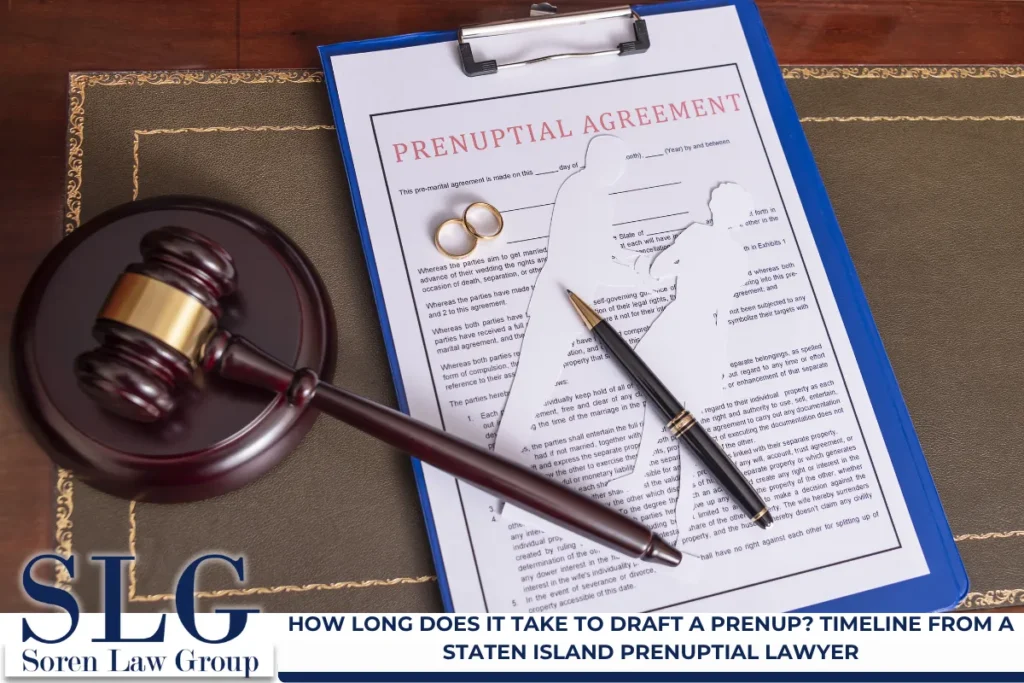
A Staten Island prenuptial lawyer can tell you something most couples do not want to hear: drafting a prenup takes longer than you think. A typical prenup takes 6 to 10 weeks to finalize, and the ideal lead time is 6 months before your wedding. The problem is that most people wait, assuming a prenuptial agreement is something they can handle in a few days. By the time deposits are paid, invitations are mailed, and family members have booked flights, the pressure to sign quickly can compromise both the document and the relationship. Prenups provide peace of mind regarding financial matters, but only when they are done right. This article walks you through every phase of the prenup process, with realistic dates and practical guidance for keeping things on track in Staten Island.
Key Takeaways
- Most prenuptial agreements in Staten Island take about 6 to 10 weeks of active work, but couples should start the process 4 to 6 months before the wedding date.
- The complexity of marital property, business interests, and back-and-forth negotiations can push the timeline past 12 weeks.
- New York requires voluntary, informed, signed-and-acknowledged agreements, so rushing close to the ceremony creates real enforceability risks.
- Early conversation with a family law attorney avoids last-minute stress and gives both parties the space to make informed decisions.
How Long Does It Really Take to Draft a Prenup in Staten Island?
Drafting a prenuptial agreement typically takes 2 to 3 months from start to finish. The typical overall timeline for a straightforward prenuptial agreement is 4 to 8 weeks of active work, but calendar time stretches when you factor in scheduling gaps, attorney availability, and response times from both parties.
In Staten Island, the timeline for a prenuptial agreement can vary based on document complexity and negotiation issues. Here is a general breakdown:
- A professional couple with modest assets, a few bank accounts, and no major disagreements can often finish in 4 to 6 weeks.
- An entrepreneur who owns a business, holds multiple properties, and has separate funds from a prior marriage may need 8 to 12 weeks or longer.
There is no fixed statutory waiting period in New York that dictates how many days or weeks the process must take. However, the amount of time you allow directly affects whether a court later views the signing as voluntary or pressured. Getting a prenup early allows for calm financial planning and avoids emergencies days before the ceremony.
Overview of the New York Prenuptial Agreement Legal Process
The process of creating a prenuptial agreement involves several steps: consultation, disclosure, drafting, negotiation, and execution. Each stage builds on the one before it, and skipping or compressing any of them creates risk.
Under New York law, here are the high-level steps from first call to final signing:
- Initial consultation with a prenuptial lawyer
- Full financial disclosure by both parties
- Drafting the first version of the agreement
- Independent lawyer review for each partner
- Negotiation and revisions
- Signing with proper acknowledgment before a notary
New York’s Domestic Relations Law § 236(B)(3) sets out the requirements for a valid prenuptial agreement. The document must be in writing, signed by both parties, and acknowledged in the same manner required to entitle a deed to be recorded. Prenups must be in writing to be enforceable under New York state law.
Both sides should have independent legal counsel for stronger enforceability. While prenups can address property division and spousal support, they cannot address child custody or child support issues, as those matters remain subject to future court determination based on the best interests of the children involved.
Phase 1: Initial Consultation and Planning (First 1 to 2 Weeks)
Everything starts with a conversation. During the first meeting, a family law attorney will ask about your wedding date, your financial expectations, your concerns, and what you want the agreement to accomplish.
This is also where the attorney evaluates whether a prenuptial agreement or a possible postnuptial agreement signed after marriage would better fit the couple’s situation. If the wedding is imminent and there is not enough time for a thorough prenup process, that distinction matters.
Realistic timing for this phase: scheduling a consultation usually takes a few days to a week, followed by a second meeting after each partner reflects on priorities.
Documents to start gathering early:
- Recent tax returns and pay stubs
- Bank account and investment statements
- Property deeds and mortgage documents
- Business ownership records
- Retirement account statements
- Outstanding debts and loan balances
Having these ready before the attorney prepares the first draft saves significant time later.
Phase 2: Full Financial Disclosure and Asset Organization (1 to 3 Weeks)
Full financial disclosure is essential for a valid prenuptial agreement in New York. Both parties must collect and disclose financial documentation to create a prenup that will hold up in court. Incomplete or inaccurate disclosure is one of the most common reasons agreements get thrown out during divorce proceedings.
Each partner must list all assets, debts, income, and financial expectations, including anticipated inheritances or bonuses. The types of marital property and separate property frequently addressed include:
- Real estate holdings
- Bank accounts and joint accounts
- Retirement plans and pensions
- Business interests and ownership stakes
- Stock options and investment portfolios
For simple finances, organizing everything can take about a week. More complex portfolios with businesses or multiple properties may need 2 to 3 weeks, especially if outside appraisals are necessary.
Hiding assets can cause a prenuptial agreement to be invalidated by New York courts. Courts take disclosure seriously, and a gap in the financial picture can unravel the entire document years later.
Phase 3: Drafting the First Version of the Prenup (1 to 3 Weeks)
Once disclosure is complete, the attorney converts your goals and finances into contract language. The first draft of a prenup agreement typically covers:
- Division of marital assets and debts in the event of a divorce
- Treatment of premarital and separate property
- Spousal support terms, including potential caps or waivers
- Coordination with estate planning documents like wills
Prenups can specify spousal support terms in advance, which removes one of the most contentious issues from potential future separation disputes. Prenups can also protect inherited wealth from being divided, a concern that comes up frequently in Staten Island families with generational property.
Drafting speed depends on the clarity of your instructions and the complexity of your finances. A straightforward agreement might be ready in about a week, while one involving trusts, tax implications, or a partner’s own business could take two to three weeks.
This is the best stage to raise questions about future scenarios rather than trying to fix problems right before signing.
Read When Should You Get a Prenup? A Staten Island Prenuptial Lawyer Guide
Phase 4: Independent Lawyer Review for Each Partner (1 to 2 Weeks)
Each partner should have their own prenuptial attorney review the draft. New York courts look favorably on independent legal counsel for both parties during prenuptial agreement formation, although it is not an absolute statutory requirement; courts look closely at whether each person had their own legal representation when evaluating enforceability.
During this phase, the reviewing lawyer goes through the draft line by line, explains every right being waived, and suggests changes where appropriate. An independent attorney protects the signer from later claims that they did not understand what they were agreeing to.
Timing depends on attorney schedules in Staten Island. Expect several days to two weeks to receive detailed feedback from each side.
Having separate counsel is not merely a formality. In cases like A.N. v. E.N., courts invalidated agreements where one partner had no meaningful opportunity to review with their own lawyer. Careful review at this stage preserves the agreement’s value if it is ever tested during divorce.
Phase 5: Negotiation, Revisions, and Final Agreement (1 to 4 Weeks)
Most of the timeline variation happens during negotiations. If both parties are on the same page about key terms, this phase might wrap up in a single week. If there are significant disagreements, it can stretch to a month or more.
Common topics of negotiation include:
- Treatment of the marital home
- How business interests are valued and divided
- Savings and retirement contributions during the marriage
- Spousal support limits or waivers
- Handling of separate funds versus joint accounts
Consider two scenarios. A couple who largely agrees on financial matters might exchange one round of revisions and reach the final draft within seven days. A couple working through disagreements about a family business or significant real estate holdings may go through several revision rounds over three to four weeks.
Respectful communication matters here. The goal is not for one spouse to win but for both partners to protect their concerns while preserving the relationship. If conflicts become serious, mediation with a neutral professional can keep the process moving and prevent breakdowns.
Signing, Notarization, and Timing Before the Wedding
Execution formalities and timing are critical. Under New York law, a pre nuptial agreement must be signed before the marriage ceremony and acknowledged in the same manner as a deed. This means each party must sign before a notary or other authorized officer who completes a proper acknowledgment certificate.
Most attorneys recommend finalizing prenups 30 days before the wedding. Attorneys often recommend signing at least 30 days before the wedding to reduce claims of duress; New York does not impose a 30-day statutory minimum. While some states mandate a minimum waiting period of 7 days between the final draft and signing, New York does not impose that specific statutory requirement. However, New York courts scrutinize timing closely.
In M.M. v. D.M., a prenup signed the day before the wedding raised serious questions about overreaching. Similarly, in Anderson v. Anderson, a signature acknowledgment delayed by nearly seven years was held ineffective and the agreement was unenforceable.
The signing meeting itself is straightforward: a final read-through, questions answered, signatures collected, and acknowledgments taken. Afterward, store copies securely and coordinate with wills, beneficiary designations, and other legal documents.
Factors That Can Speed Up or Slow Down a Staten Island Prenup Timeline
No two cases move at the same pace. Here is what drives the schedule in either direction.
Factors that shorten the timeline:
- Starting early and setting a clear plan
- Organized financial records ready at intake
- Clear goals and minimal disputes between parties
- Quick responses to attorney requests
- Experienced attorneys familiar with the legal process
Factors that extend the timeline:
- Business valuations or appraisals of complex assets
- Multiple properties or international holdings
- Prior marriages with existing support or custody orders
- Scheduling conflicts with lawyers during busy seasons
- One partner slow in responding to draft revisions
Complex assets can extend prenup drafting beyond 12 weeks. Financial complexity can extend the timeline for creating a prenuptial agreement significantly, and couples with complex assets may need more than 6 months to complete everything properly. Scheduling realities around holidays and peak wedding seasons in Staten Island add further pressure.
Treat the prenup as part of overall wedding planning, not an afterthought. Last-minute pressure can backfire in court and damage the relationship.
Comparing Prenuptial Agreements and Postnuptial Agreements for Timing
Some couples delay the conversation and later consider a postnuptial agreement after they are already married. The timing difference is simple: premarital agreements must be signed before the marriage ceremony, while a post nuptial agreement is signed afterward.
The process steps are similar. Both require full disclosure, independent counsel, written execution, and fairness. However, the emotional dynamics may shift once the couple is legally married and already sharing money and property.
Waiting to sign a postnuptial agreement does not solve the problem of a rushed prenup signed days before the wedding day. Early planning remains the better path. A local family law attorney can explain how postnuptial agreements interact with existing marital property and estate plans if timing simply does not allow for a prenup.
Planning Backward From Your Wedding Date: Practical Timeline Examples
The smartest approach is to work backward from your ceremony date. Start prenup discussions at least 6 months before the wedding, and starting the prenuptial agreement process 3 to 6 months before the wedding is advisable for most couples.
Here is a sample timeline for a spring wedding:
| Months Before Wedding | Action |
| 6 months | Initial consultation, choose attorneys, set goals |
| 5 months | Complete financial disclosure, gather all legal documents |
| 4 months | First draft prepared and reviewed |
| 3 months | Independent attorney review, negotiation rounds |
| 2 months | Final draft agreed upon and signed |
| 1 month | Buffer period, coordinate with estate plan |
Now compare a compressed scenario where the couple starts only 8 weeks out:
| Weeks Before Wedding | Action |
| Week 1 | Consultation and rush disclosure |
| Weeks 2-3 | Drafting under time pressure |
| Week 4 | Independent lawyer review, limited time for feedback |
| Weeks 5-6 | Compressed negotiation, possible unresolved issues |
| Week 7 | Signing with minimal buffer |
| Week 8 | Wedding |
The compressed version leaves almost no room for delays. If any step takes longer than expected, the couple faces a choice between signing under pressure or postponing. If timing becomes too tight, discuss options with counsel rather than signing under obvious pressure. A typical prenup takes 6 to 10 weeks to finalize, so building in extra calendar time is always the safer approach.
How a Prenuptial Agreement Interacts With Divorce, Support, and Property Division
Understanding how a prenup functions in a future separation helps couples prioritize what to negotiate now. Prenups clarify asset division in case of divorce, removing guesswork and reducing conflict during an already difficult time.
A valid prenup guides equitable distribution of assets and debts within New York’s framework. Without one, state law governs property division, which may not reflect what either partner would have chosen. Prenups help avoid lengthy and costly divorce proceedings by establishing clear terms in advance.
The agreement can address spousal support, but it cannot make final determinations about child custody or child support. Those decisions remain with the court, which will always prioritize the best interests of any children involved. The agreement also cannot override certain things that violate public policy.
Courts may refuse to enforce provisions that are unconscionable at the time of enforcement. Clear, fair terms drafted with proper legal representation and full financial disclosure give the document its strongest chance of holding up. Finding lawyers who understand both the drafting and enforcement side of family law is essential for protecting your plan long term.
Staten Island Prenuptial Lawyer – Soren Law Group
At Soren Law Group, we help couples in Staten Island navigate the prenup process from the very first conversation through disclosure, drafting, lawyer review, and signing. We understand that discussing finances before a wedding can feel uncomfortable, but our goal is to make the legal process straightforward and respectful for both parties involved.
We focus on tailored solutions that protect your assets, reduce the potential for future conflict, and respect each partner’s concerns. Whether your matter involves a family business, real estate, or simply getting your financial expectations on paper, we are here to help.
Early consultation helps avoid last-minute pressure and strengthens your agreement’s enforceability. Contact us today at (718) 815-4500 or fill out our contact form to schedule a free consultation with a prenuptial lawyer who knows Staten Island.
Frequently Asked Questions
How Late Is Too Late to Start a Prenup Before My Wedding?
There is no formal statutory deadline in New York, but starting within a few weeks of the wedding significantly increases the risk of a duress argument. Courts examine whether each party had realistic time to obtain their own attorney, review the document, and consider the terms without feeling pressured. Most practitioners recommend beginning at least 3 to 6 months before the ceremony. If your date is close, speak with counsel immediately to review your options, which may include adjusting your timeline or considering a postnuptial agreement after the marriage. The safest approach is to avoid treating the agreement as a last-minute item alongside seating charts and vendor contracts.
What If My Fiance Lives Outside New York but We Are Marrying in Staten Island?
Each party can retain an attorney licensed in the jurisdiction where that lawyer practices, provided the agreement itself is drafted to comply with New York requirements under New York law. Coordinating across locations adds time for remote meetings, mailing or secure electronic transmission of drafts, and scheduling the signing with proper acknowledgments. If one partner visits Staten Island only occasionally, plan for extra weeks in each phase. Both attorneys should discuss where the couple expects to live and hold assets so the document reflects the right legal framework. Starting earlier than usual is strongly recommended when distance and time zones are involved.
Can a Prenup Be Changed Later If Our Finances or Goals Shift?
A signed prenuptial agreement can often be amended or superseded by a later written agreement, such as a postnuptial contract. Any change should follow similar safeguards: full disclosure, independent advice from each partner’s attorney, and proper execution formalities under New York law. Common life changes that prompt updates include the sale of a business, a major inheritance, the birth of children, or the purchase of new real estate. Revisions typically take less time than starting from scratch, but they still require careful lawyer review on both sides. Periodic review with a family law practitioner is a smart part of broader financial and estate planning.
Do We Both Need to Appear in Person in Staten Island to Sign the Prenup?
New York requires proper acknowledgment of the agreement, but both parties do not always need to be physically in the same room if logistics are handled correctly. Many couples prefer an in-person signing with both attorneys present in Staten Island for clarity and a clean record. Remote notarization rules have evolved in recent years, so couples must consult their counsel about what is currently permitted under New York state law. Mailing original signature pages and coordinating multiple acknowledgments can extend the timeline if the parties are in different locations. Whatever method is used must clearly document voluntary, informed signatures before the marriage takes place.
What Happens If We Postpone or Move Our Wedding After Signing the Prenup?
A properly executed prenuptial agreement generally becomes effective upon the marriage, not at the moment of signing. A date change alone does not automatically void it. However, if there is a long delay or a major financial change between signing and the new wedding day, couples should review whether any terms need updating. Cancelling the wedding entirely means the agreement never takes effect because there is no marriage. Notify your attorney of any substantial change in date or circumstances so they can confirm whether additional steps are needed. Modest scheduling shifts usually do not require redrafting the document.
Disclaimer
This article provides general information about prenuptial agreement timelines in Staten Island, New York, and does not constitute individualized legal advice. Consult a qualified attorney for guidance specific to your situation.
Read Can Paternity Be Challenged After It’s Legal? Ask a Staten Island Paternity Law Attorney